[Spine Surgery]
Kyphoplasty and Vertebroplasty (Bone Cement Procedures)
Injecting bone cement into a collapsed vertebra through a thin cannula: kyphoplasty vs vertebroplasty, who it is for, the procedure and the research.
Written by: Asst. Prof. Dr. Altan Demirel · Published: · about 5 min read
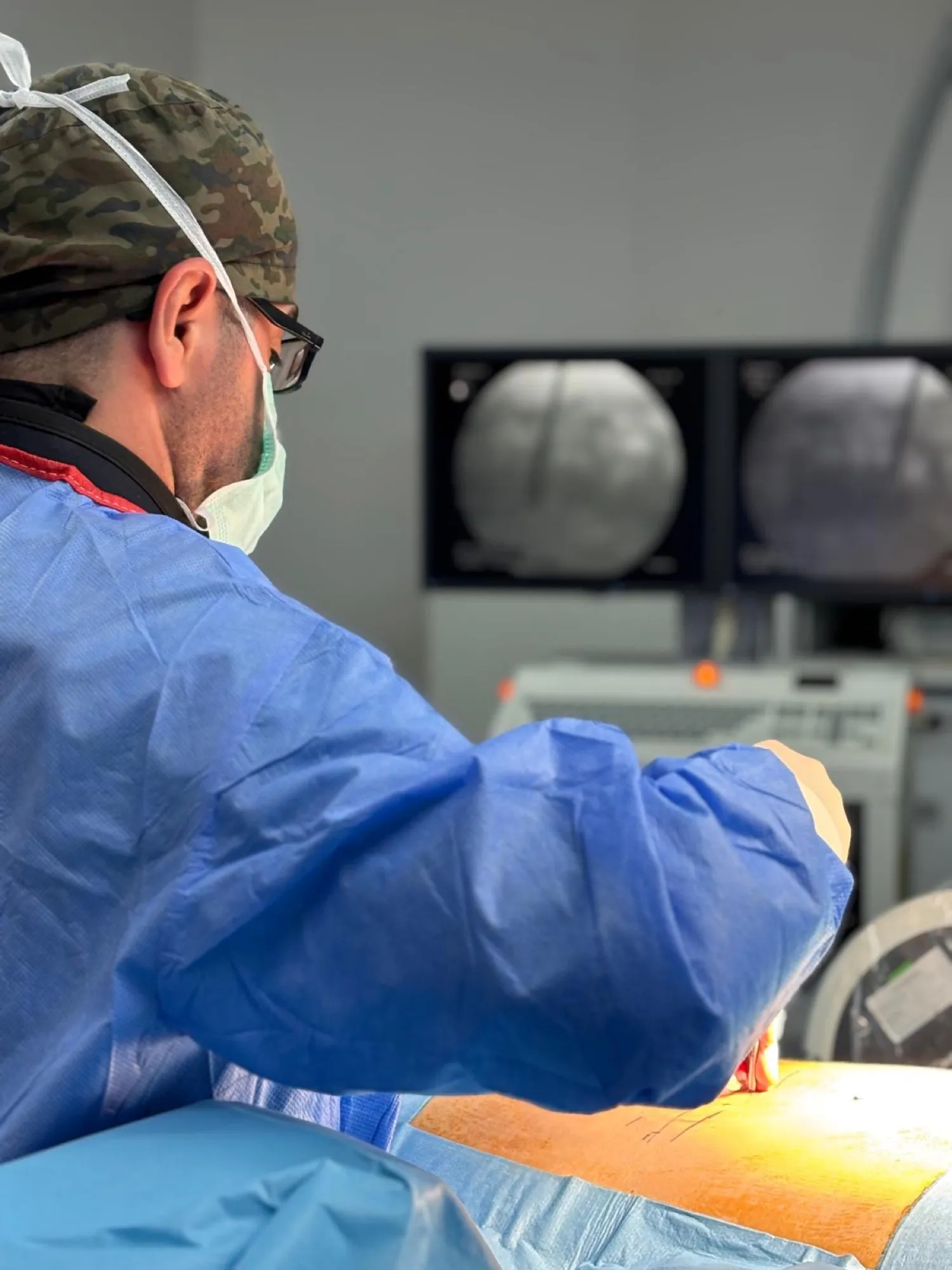
Kyphoplasty and vertebroplasty reach a collapsed or fractured spinal bone (vertebra) through the skin with a thin cannula and inject medical bone cement into it. The cement hardens within minutes and stabilises the fractured vertebra from the inside, which is why the procedure is also known as bone cementing.
It is done under fluoroscopy (live X-ray); there is no incision, only a small puncture where the cannula enters. It is most often used for compression fractures caused by osteoporosis and when cancer affects the spine.
Kyphoplasty and vertebroplasty: the difference
- Vertebroplasty: the bone cement is injected through the cannula directly into the fractured vertebra.
- Kyphoplasty: before the cement, a small balloon is inflated inside the vertebra to create a cavity. The balloon is removed and the cavity is filled with cement at lower pressure. Part of the lost vertebral height can be restored at this stage.
The choice depends on the age of the fracture, the degree of collapse and whether the back wall of the vertebra is intact.
Who is it for?
- Painful spinal compression fractures caused by osteoporosis
- Fractures caused by cancer spreading to the spine or by multiple myeloma
- Some spinal haemangiomas that cause pain or weaken the vertebra
Examination and imaging should show that the fracture is the source of the pain. MRI helps tell whether a fracture is recent and still healing.
Bone cementing is not suitable for old, healed fractures, for infection in or around the vertebra, or when a fracture fragment presses on the spinal cord or nerves; these situations need other treatments or open surgery.
How is the procedure done?
- The patient lies face down; the procedure is done under sedation or general anaesthesia.
- Using fluoroscopy, the thin cannula is placed into the vertebral body through the bony bridge at the back of the vertebra (pedicle).
- In kyphoplasty, a balloon is inflated to create a cavity inside the vertebra.
- The bone cement is injected in a controlled way under imaging and left to harden.
- The cannula is removed and the entry point is covered with a small dressing.
The duration depends on the number of vertebrae treated. Most patients go home the same day or the next day.
After the procedure
Patients get up a few hours after the procedure. In most patients the fracture pain eases clearly in the first days; the entry point may be mildly tender for a few days.
The bone cement is permanent and does not need to be removed. If osteoporosis caused the fracture, treatment for it is planned separately; this matters at least as much as the procedure itself for preventing new fractures.
Risks
- Cement leaking outside the vertebra: usually without symptoms; rarely pressure on nerves or the spinal cord, and very rarely cement reaching the lung vessels
- A new fracture in a neighbouring vertebra
- Rarely, infection or bleeding
Patients who take blood thinners should mention this before the procedure; when to stop the medication is planned with the doctor.
What does the research show?
In studies comparing kyphoplasty with non-surgical care, kyphoplasty led to faster recovery. In the FREE trial of 300 patients (Lancet, 2009), quality of life improved clearly more in the kyphoplasty group at one month. In the CAFE trial in patients with cancer (Lancet Oncology, 2011), kyphoplasty reduced back-pain-related disability at one month significantly more than non-surgical care.
Studies comparing vertebroplasty with a sham (placebo) procedure have had different results. Two trials published in 2009 and VERTOS IV (BMJ, 2018) found no significant difference in pain compared with the sham procedure. In the VAPOUR trial (Lancet, 2016), in fractures less than six weeks old, a clear reduction in pain at day 14 was more common in the vertebroplasty group. A Cochrane review (2018) concluded that vertebroplasty shows no important benefit over a sham procedure in osteoporotic fractures.
This difference suggests that factors such as the age of the fracture, the severity of the pain and patient selection shape the result. The decision to use bone cement is therefore made by assessing the fracture’s appearance on MRI together with the patient’s symptoms.
Frequently asked questions
- 01When does the pain ease after kyphoplasty?
- In most patients the fracture pain eases clearly in the first days. The entry point may be mildly tender for a few days.
- 02Does the bone cement stay in the body?
- Yes. The cement hardens inside the vertebra and stays there permanently; it does not need to be removed.
- 03Does the procedure need general anaesthesia?
- It can be done under sedation or general anaesthesia. Which is suitable depends on the patient’s general health and the number of vertebrae treated.
- 04Kyphoplasty or vertebroplasty?
- The decision depends on the age of the fracture, the degree of collapse and whether the back wall of the vertebra is intact. In kyphoplasty a balloon creates a cavity before the cement is injected.
- 05Can a new fracture happen after the procedure?
- In patients with osteoporosis, fractures can develop in other vertebrae. This is why treatment for osteoporosis is planned alongside the procedure.
References
- Wardlaw D, et al. Efficacy and safety of balloon kyphoplasty compared with non-surgical care for vertebral compression fracture (FREE): a randomised controlled trial. Lancet. 2009;373(9668):1016-1024.
- Berenson J, et al. Balloon kyphoplasty versus non-surgical fracture management for treatment of painful vertebral body compression fractures in patients with cancer: a multicentre, randomised controlled trial. Lancet Oncol. 2011;12(3):225-235.
- Clark W, et al. Safety and efficacy of vertebroplasty for acute painful osteoporotic fractures (VAPOUR): a multicentre, randomised, double-blind, placebo-controlled trial. Lancet. 2016;388(10052):1408-1416.
- Buchbinder R, et al. A randomized trial of vertebroplasty for painful osteoporotic vertebral fractures. N Engl J Med. 2009;361(6):557-568.
- Kallmes DF, et al. A randomized trial of vertebroplasty for osteoporotic spinal fractures. N Engl J Med. 2009;361(6):569-579.
- Firanescu CE, et al. Vertebroplasty versus sham procedure for painful acute osteoporotic vertebral compression fractures (VERTOS IV): randomised sham controlled clinical trial. BMJ. 2018;361:k1551.
- Buchbinder R, et al. Percutaneous vertebroplasty for osteoporotic vertebral compression fracture. Cochrane Database Syst Rev. 2018;11:CD006349.